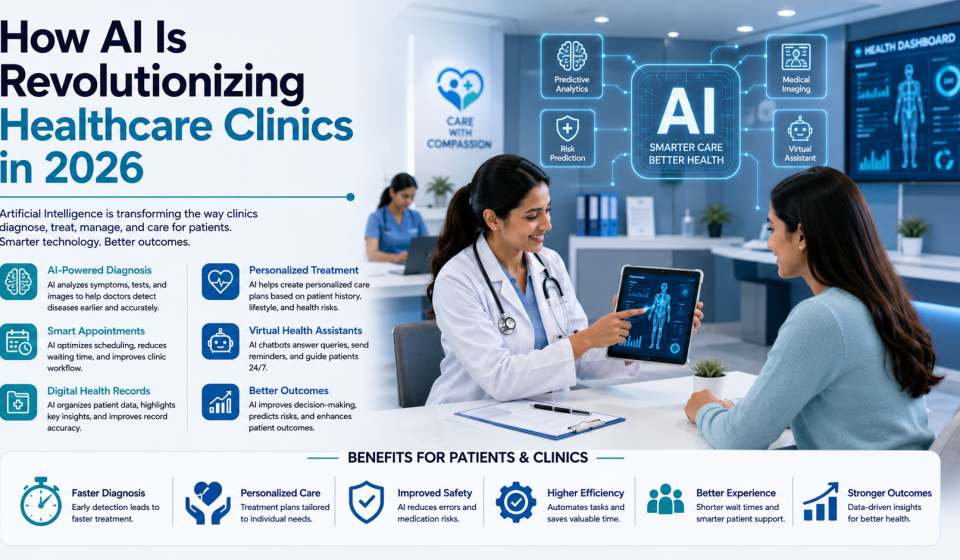

Artificial intelligence is changing the way healthcare clinics work in 2026. From faster diagnosis to smarter patient records, AI is helping clinics deliver better, quicker, and more personalized care. In the past, many clinics depended mainly on manual records, long waiting times, and traditional consultation methods. Today, AI-powered tools are improving almost every part of the clinic experience. Healthcare clinics are becoming more digital, data-driven, and patient-focused. AI helps doctors detect health risks earlier, manage appointments, support medical decisions, automate routine tasks, and provide personalized treatment guidance. This does not mean AI is replacing doctors. Instead, it is helping healthcare professionals work more efficiently and make better decisions.
AI-Powered Diagnosis
One of the biggest benefits of AI in healthcare clinics is improved diagnosis. AI tools can analyze patient symptoms, medical history, lab reports, imaging results, and risk factors to support doctors in identifying possible conditions.
For example, AI can help detect patterns in blood reports, skin images, eye scans, heart readings, and other medical data. This helps doctors make faster and more accurate decisions.
AI does not replace clinical judgment, but it acts as a helpful assistant. When used properly, it can reduce missed warning signs and support early detection.
Faster Patient Screening
Clinics often see many patients every day. AI-powered screening tools help clinics understand patient needs before the consultation begins.
Patients may answer digital health questions through an app, website, or clinic kiosk. AI can then organize symptoms, identify urgency, and suggest the right department or doctor.
This makes the clinic process faster and more organized. Patients with urgent needs can be prioritized, while routine cases can be handled efficiently.
Personalized Treatment Plans
Every patient is different. AI helps clinics create more personalized treatment plans based on health history, lifestyle, age, test results, medication use, and disease risk.
For example, a patient with diabetes may receive customized diet suggestions, medication reminders, glucose tracking, and lifestyle recommendations. A patient with heart risk may receive alerts about blood pressure, cholesterol, and follow-up needs.
Personalized care improves treatment quality because patients receive guidance that matches their unique needs.
Improved Chronic Disease Management
Chronic diseases such as diabetes, hypertension, asthma, thyroid problems, and heart disease require regular monitoring. AI is helping clinics manage these conditions more effectively.
AI tools can track patient data over time and alert doctors when something changes. For example, if a patient’s blood sugar or blood pressure readings become abnormal, the clinic can follow up earlier.
This helps prevent complications and reduces emergency visits. In 2026, AI-based chronic care management is becoming one of the most valuable clinic services.
Smart Appointment Scheduling
Long waiting times are one of the biggest problems in healthcare clinics. AI-powered scheduling systems help solve this by managing appointments more intelligently.
AI can predict busy hours, reduce appointment gaps, send reminders, and reschedule visits when needed. It can also help clinics assign the right time slots based on consultation type.
This improves patient satisfaction and allows doctors to use their time more efficiently.
Digital Health Records
AI is improving the way clinics manage patient records. Digital health records allow doctors to access medical history, test results, prescriptions, allergies, and previous visits quickly.
AI can also summarize large records, highlight important information, and detect missing details. This saves time during consultations and reduces errors.
Better records mean better continuity of care, especially for patients who visit clinics regularly.
AI in Medical Imaging
Many clinics use imaging services or refer patients for scans. AI can support the analysis of X-rays, CT scans, MRIs, ultrasounds, eye scans, and skin images.
AI tools can help identify suspicious patterns, early disease signs, or abnormalities that may need further review. This is especially useful in radiology, dermatology, ophthalmology, and cancer screening.
Faster image analysis can support early diagnosis and better treatment planning.
Virtual Health Assistants
AI-powered virtual assistants are becoming common in modern clinics. These assistants can answer basic patient questions, provide appointment details, remind patients about medicines, and guide them before or after visits.
For example, a chatbot may help patients understand clinic hours, required documents, test preparation, or follow-up instructions.
Virtual assistants reduce staff workload and give patients quick support outside regular consultation time.
Better Preventive Healthcare
AI is helping clinics shift from treatment-based care to preventive healthcare. By analyzing patient data, AI can identify people who may be at risk of certain diseases.
For example, AI may detect risk factors for diabetes, heart disease, obesity, kidney problems, or mental health concerns. Clinics can then recommend screenings, lifestyle changes, or early interventions.
Preventive care helps patients avoid serious health problems and reduces long-term healthcare costs.
Remote Monitoring and Wearable Devices
In 2026, many patients use wearable devices such as smartwatches, fitness bands, glucose monitors, and blood pressure trackers. AI can analyze data from these devices and help clinics monitor patients remotely.
This is useful for elderly patients, chronic disease patients, and people recovering after treatment. Doctors can track trends and identify problems before they become serious.
Remote monitoring makes healthcare more continuous, instead of depending only on clinic visits.
AI for Medication Safety
Medication errors can cause serious health problems. AI can help clinics improve medication safety by checking drug interactions, allergies, dosage patterns, and patient history.
For example, if a patient is already taking certain medicines, AI can alert the doctor about possible risks before prescribing another medicine.
This improves patient safety and supports better clinical decisions.
Faster Lab Report Analysis
Clinics often handle many lab reports every day. AI can help analyze reports quickly and highlight abnormal results.
Instead of manually reviewing every value, doctors can use AI to identify important changes and trends. This is especially helpful for patients with repeated tests, such as diabetes, thyroid, cholesterol, liver function, and kidney function.
Faster report analysis improves follow-up and treatment planning.
Reducing Administrative Work
Doctors and clinic staff spend a lot of time on paperwork, billing, scheduling, data entry, and documentation. AI can automate many routine tasks.
This gives healthcare professionals more time to focus on patients. AI can help with digital prescriptions, insurance forms, appointment reminders, patient summaries, and billing support.
Reducing administrative burden improves clinic efficiency and patient experience.
AI and Telemedicine
Telemedicine has become an important part of healthcare. AI improves virtual consultations by helping collect symptoms, organize patient history, and support follow-up reminders.
AI can also help decide whether a patient needs an in-person visit or can be managed through online consultation.
This makes telemedicine safer, faster, and more useful for patients who cannot easily travel to clinics.
Better Patient Engagement
AI helps clinics stay connected with patients after their appointments. Automated reminders can encourage patients to take medicines, attend follow-ups, complete lab tests, or follow lifestyle advice.
This improves treatment adherence. Many patients fail to follow medical advice because they forget or do not fully understand instructions. AI-powered engagement tools help bridge that gap.
When patients stay engaged, treatment results improve.
Supporting Doctors, Not Replacing Them
A common concern is that AI may replace doctors. In healthcare clinics, AI works best as a support tool, not as a replacement.
Doctors bring experience, empathy, ethical judgment, communication skills, and human understanding. AI provides data analysis, pattern detection, reminders, and workflow support.
The best healthcare model combines human care with smart technology.
Challenges of AI in Clinics
While AI offers many benefits, clinics must use it carefully. Important challenges include data privacy, accuracy, cost, staff training, patient trust, and ethical use.
Clinics must protect patient information and use reliable AI tools. Doctors should always review AI suggestions before making final decisions.
Responsible AI use is essential for safe and high-quality healthcare.
Future of AI-Powered Clinics
The future of healthcare clinics will include smarter diagnosis, predictive care, personalized wellness plans, remote monitoring, AI-assisted imaging, digital prescriptions, and integrated patient records.
Clinics that adopt AI responsibly will provide faster, safer, and more patient-centered care. AI will help clinics become more efficient while improving health outcomes.
In 2026 and beyond, AI-powered clinics will play a major role in building the future of healthcare.
source
https://l1nq.com/gbczd40
https://l1nq.com/rkjufkj
https://sl1nk.com/f1zt14d
https://l1nq.com/ow9hy8i
Conclusion
AI is revolutionizing healthcare clinics in 2026 by improving diagnosis, patient screening, treatment planning, chronic disease management, appointment scheduling, digital records, telemedicine, and preventive care. It helps doctors work smarter and allows patients to receive faster, more personalized, and more convenient healthcare.
However, AI is not a replacement for doctors. Its real value comes when technology supports human medical expertise. Clinics that combine AI with compassionate care can improve treatment quality, reduce errors, save time, and create better patient experiences.
As healthcare continues to evolve, AI-powered clinics will become an important part of modern medicine and a key driver of better health outcomes.
Frequently Asked Questions
1. How is AI used in healthcare clinics?
AI is used for diagnosis support, patient screening, appointment scheduling, digital records, lab report analysis, telemedicine, chronic disease monitoring, and patient reminders.
2. Can AI replace doctors in clinics?
No. AI supports doctors by analyzing data and improving efficiency, but doctors make final medical decisions and provide human care.
3. How does AI improve patient care?
AI improves patient care by helping with early diagnosis, personalized treatment, faster follow-ups, medication safety, and better chronic disease management.
4. Is AI safe for healthcare clinics?
AI can be safe when clinics use reliable tools, protect patient data, train staff properly, and ensure doctors review AI-generated suggestions.
5. What is the future of AI in healthcare clinics?
The future includes predictive healthcare, remote monitoring, AI-assisted diagnosis, personalized wellness plans, digital records, and smarter patient engagement.