
In this guide, we’ll discuss everything patients should know before visiting a specialty clinic, helping you feel informed, confident, and ready for your appointment.
Visiting a specialty clinic can be an important step toward receiving expert care for specific health conditions. Unlike general healthcare clinics that provide primary care and routine medical services, specialty clinics focus on diagnosing, treating, and managing particular diseases or areas of medicine, such as cardiology, dermatology, orthopedics, neurology, gastroenterology, and women’s health. These clinics are staffed by healthcare professionals with advanced training and experience in their respective fields, ensuring patients receive specialized and comprehensive care. Preparing for a specialty clinic appointment can make your visit more productive and help your healthcare provider better understand your medical history and current concerns. Knowing what to expect before your appointment—from gathering medical records and understanding referral requirements to preparing questions and following pre-appointment instructions—can improve communication, reduce stress, and lead to better treatment outcomes.
What Is a Specialty Clinic?
A specialty clinic is a healthcare facility that focuses on diagnosing, treating, and managing specific medical conditions or specialized areas of healthcare.
Examples of specialty clinics include:
- Cardiology clinics
- Orthopedic clinics
- Dermatology clinics
- Neurology clinics
- Gastroenterology clinics
- Endocrinology clinics
- Urology clinics
- Women’s health clinics
- Oncology clinics
- Ophthalmology clinics
These clinics provide advanced expertise and treatment options that may not be available in a general primary care setting.
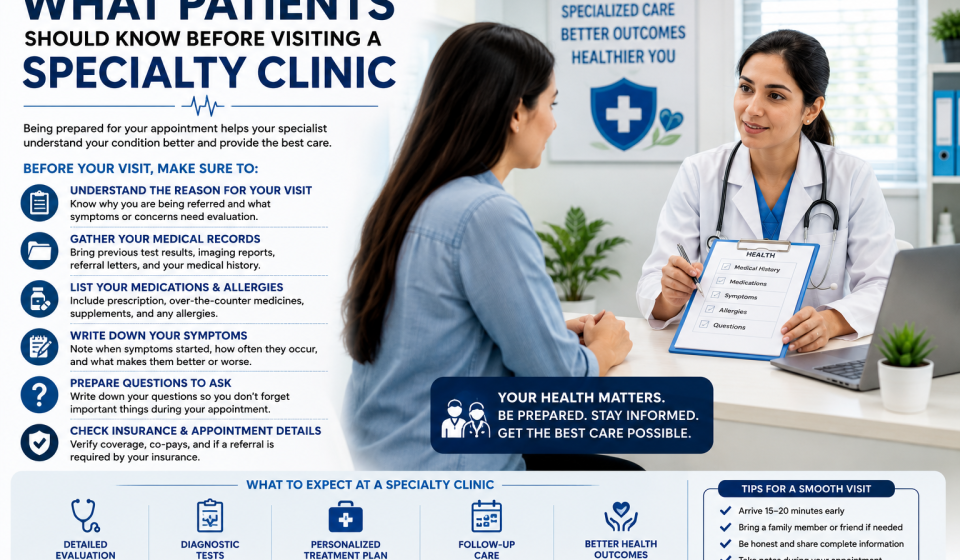
Understand Why You Are Being Referred
Many patients visit specialty clinics after receiving a referral from their primary care physician.
A referral may be recommended if:
- Your symptoms require further evaluation.
- A specialized diagnosis is needed.
- Advanced testing is required.
- Your condition needs ongoing specialist care.
- Previous treatments have not been successful.
Understanding the reason for your referral helps you communicate more effectively with your specialist.
Gather Your Medical Records Before Your Appointment
Bringing complete medical information allows your specialist to make informed decisions.
Important documents include:
- Previous medical records
- Referral letter
- Laboratory test results
- Imaging reports (X-rays, MRI, CT scans)
- Vaccination history
- Hospital discharge summaries
- Insurance information
Having organized records can reduce duplicate testing and speed up diagnosis.
Prepare a Complete List of Medications
Your specialist should know everything you’re currently taking.
Include:
- Prescription medications
- Over-the-counter medicines
- Vitamins
- Herbal supplements
- Allergy medications
Also mention:
- Medication allergies
- Previous side effects
- Recently discontinued medications
Accurate medication information helps prevent harmful drug interactions.
Write Down Your Symptoms
Many patients forget important details during appointments.
Before your visit, note:
- When symptoms started
- How often they occur
- Pain level
- What makes symptoms worse
- What provides relief
- Any associated symptoms
Providing detailed information improves diagnostic accuracy.
Prepare Questions to Ask Your Specialist
Appointments often feel short, so preparing questions in advance ensures you receive the information you need.
Examples include:
- What is causing my symptoms?
- Do I need additional tests?
- What treatment options are available?
- What are the possible side effects?
- How long will recovery take?
- Should I change my diet or lifestyle?
- Will I need follow-up visits?
Writing questions beforehand prevents forgetting important concerns.
Follow Any Pre-Appointment Instructions
Some specialty clinics require patients to prepare before arriving.
Instructions may include:
- Fasting before blood work
- Avoiding certain medications
- Drinking extra water
- Bringing imaging discs
- Completing online forms
- Wearing loose clothing for physical examinations
Following instructions helps avoid delays or rescheduling.
Understand Potential Diagnostic Tests
Specialists may recommend additional tests to confirm a diagnosis.
Common tests include:
- Blood tests
- Ultrasound
- MRI scans
- CT scans
- ECG
- Biopsies
- Endoscopy
- Allergy testing
Ask your provider why each test is necessary and what the results may indicate.
Be Honest About Your Medical History
Open communication is essential for accurate diagnosis.
Share information about:
- Chronic illnesses
- Previous surgeries
- Family medical history
- Smoking habits
- Alcohol use
- Physical activity
- Pregnancy (if applicable)
- Mental health concerns
Providing complete information allows your specialist to recommend the most appropriate treatment.
Understand Your Insurance Coverage
Before your appointment, verify:
- Referral requirements
- Specialist network status
- Co-payments
- Deductibles
- Covered diagnostic tests
- Prescription coverage
Understanding your insurance benefits helps prevent unexpected expenses.
Bring a Family Member or Friend if Needed
For complex medical conditions, having someone accompany you can be helpful.
They can:
- Take notes
- Ask questions
- Help remember instructions
- Provide emotional support
- Assist with transportation if necessary
This is especially valuable when discussing complicated diagnoses or treatment plans.
Know What Happens After the Appointment
Your visit may not end with a diagnosis.
The specialist may recommend:
- Additional testing
- Prescription medications
- Physical therapy
- Lifestyle changes
- Surgery consultation
- Follow-up appointments
- Monitoring over several months
Be sure you understand the next steps before leaving the clinic.
Follow Your Treatment Plan Carefully
Successful treatment depends on following medical advice.
This includes:
- Taking medications correctly
- Attending follow-up appointments
- Completing recommended tests
- Following dietary guidelines
- Exercising safely
- Reporting new symptoms promptly
Active participation improves treatment outcomes.
Tips for Making the Most of Your Specialty Clinic Visit
To maximize your appointment:
- Arrive 15–20 minutes early.
- Bring identification and insurance information.
- Carry your medication list.
- Write down your questions.
- Be honest about symptoms.
- Take notes during the visit.
- Request copies of important reports.
- Schedule follow-up appointments before leaving.
Preparation helps ensure a smoother and more productive healthcare experience.
source
https://sl1nk.com/rlvh4hr
https://l1nq.com/6erxss9
https://sl1nk.com/vngwles
Conclusion
Visiting a specialty clinic is an important step toward receiving expert medical care tailored to your specific health needs. Preparing before your appointment by organizing medical records, understanding your referral, listing medications, documenting symptoms, and asking thoughtful questions allows specialists to provide more accurate diagnoses and effective treatment plans. Specialty clinics offer advanced expertise, state-of-the-art diagnostic tools, and personalized care that can significantly improve health outcomes.
By taking an active role in your healthcare and following your specialist’s recommendations, you’ll be better equipped to manage your condition, make informed decisions, and achieve the best possible results. A well-prepared patient is often the key to a more successful and efficient specialty clinic experience.
Frequently Asked Questions (FAQs)
1. What is a specialty clinic?
A specialty clinic is a medical facility that focuses on diagnosing and treating specific diseases or medical specialties, such as cardiology, dermatology, orthopedics, neurology, or gastroenterology.
2. Do I need a referral to visit a specialty clinic?
Some specialty clinics require a referral from your primary care physician, while others accept self-referred patients. This often depends on your healthcare provider and insurance plan.
3. What should I bring to my specialty clinic appointment?
Bring your identification, insurance card, referral documents (if required), medical records, recent test results, medication list, and a list of questions for your specialist.
4. Why is it important to prepare before visiting a specialist?
Preparation helps your specialist understand your medical history, avoid duplicate testing, make accurate diagnoses, and recommend the most effective treatment plan.
5. Will I need additional tests at a specialty clinic?
Possibly. Depending on your condition, the specialist may recommend blood tests, imaging studies, biopsies, endoscopy, or other diagnostic procedures to confirm a diagnosis.